The Two-Week Experiment Is Not a Test of Character
A two-week experiment helps you judge whether a small plan fits your routine, energy and timing, without turning an unfinished attempt into a verdict.
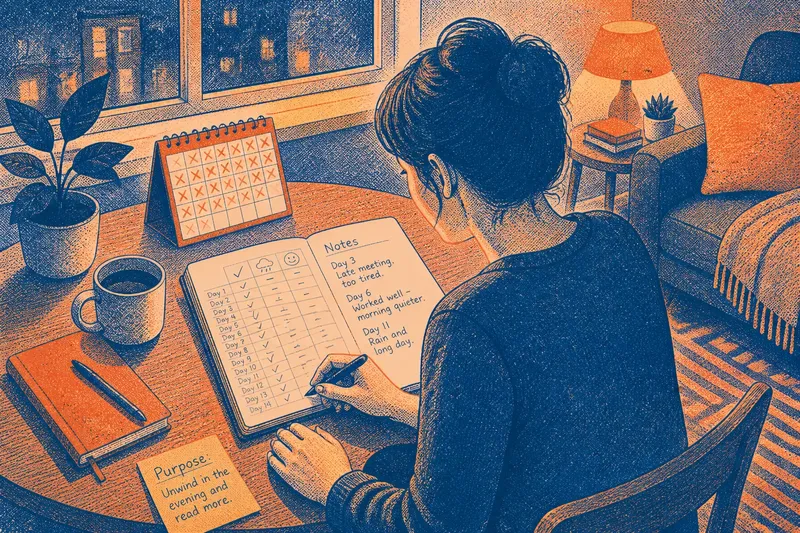
You planned to take a short walk after work, and by Thursday the plan had vanished under a late meeting and a damp coat. A two-week experiment is not a test of character; it is a way to learn whether a specific action fits the life you have now. An unfinished attempt can be useful information, though it does not tell you by itself what to change.
What is the experiment meant to tell you?
Before starting, name the uncertainty. Perhaps you do not know whether a brief walk helps you unwind, whether a regular reading slot survives family routines, or whether a task is easier before lunch than after it. The point is not to prove that you can obey a plan. It is to make one uncertain part of everyday life easier to see.
Keep the trial small enough that the question stays visible. If you are testing whether you can write regularly, choose a modest action and a clear cue, such as opening a notebook after breakfast. Do not add a new app, a complicated tracking sheet and a second goal. That is less an experiment than a small administrative department.
Decide what you will notice, not what result you must produce. You might record whether the action happened, what got in the way and how it felt to begin. A note in a diary or a tick on a paper calendar may be sufficient. The record is there to help you recall the pattern, not to grade you.
Which situation are you in?
If you have not started, what is getting in the way?
Separate reluctance from friction. If the action feels unwanted or irrelevant, revisit the reason for choosing it; if you keep forgetting, the cue may be too faint; if the materials are hard to reach, make them easier to find. These are different problems, and “try harder” is not a useful diagnosis for any of them.
If you started and then stopped, what changed?
Look for a change in the conditions: a shift at work, poor sleep, an unexpected responsibility or a task that took more effort than expected. A plan that fit one kind of day may not fit another. Note the change without turning it into a character assessment.
If you did the action but disliked it, what does that tell you?
Completion is not the only useful outcome. You may discover that the chosen time is unpleasant, the activity does not serve the aim, or the task needs company or a quieter setting. Keep the underlying purpose separate from this particular version of the plan.
If it worked on some days, what made those days different?
Compare the workable days with the difficult ones. Perhaps the action followed an existing routine, needed less preparation or took place before your energy dipped. A repeatable condition is more useful than a vague instruction to be more disciplined.
When should you keep, change or stop the plan?
Keep it when the action is reasonably manageable, serves the purpose you chose and can fit ordinary days, not only unusually calm ones. It need not feel effortless. The useful question is whether the effort seems proportionate to what you want from it.
Change one feature when the purpose still matters but the arrangement keeps getting in the way. Move the cue, reduce the preparation, choose a more suitable setting or make the action smaller. Changing one feature makes it easier to notice what may have helped; changing everything at once leaves you with a fresh plan and little insight into the old one.
Stop when the aim no longer matters, the action has become a poor match, or the cost is not one you want to carry. Stopping a trial is not the same as abandoning the broader aim. You can choose a different route, pause deliberately or decide that this is not a priority now.
Say you want to read more, so you place a book by the sofa and plan to read after dinner. Imagine that dinner is followed by household tasks, and the book stays shut, but you often have a quiet few minutes before bed. For a new trial, you could move the cue to the bedside and choose a brief reading window; the observable result would be whether reading begins there more often, not whether you have proved your dedication to books.
How can you make the result easier to interpret?
Use a short record with room for context. A note can include the planned cue, whether the action happened and one phrase about the day. “No walk; rain and late finish” says more than a blank box, while “failed again” turns an observation into a judgement.
Look for patterns, not a perfect streak. If the action happened when your materials were ready but not when you had to search for them, preparation may be the relevant feature. If it happened only when the day was quiet, the plan may need a version for busy days or a more realistic time.
Be careful about what the record cannot tell you. A missed action does not establish that you lack motivation, just as a completed action does not prove that the plan is sustainable. The record describes what happened under particular conditions; deciding what those conditions mean calls for some judgement.
What should you ask after the trial?
Was the action small enough to begin?
Notice whether starting required a long negotiation with yourself or a substantial run-up. If it did, reduce the first move or remove a preparation task before deciding that the aim itself is wrong.
Did the cue meet the day you actually had?
A cue such as “after work” may be too broad if your finishing time varies. A dependable event, like putting away your work bag, may be easier to recognise; if no cue is stable, a flexible time window may suit you better.
Did the trial serve the aim you cared about?
Ask whether doing the action moved you towards something you value, or merely satisfied the plan’s wording. If the link is weak, revise the action or reconsider the aim rather than demanding more effort from the same arrangement.
What is one sensible next move?
Choose among continuing, changing one feature, pausing or stopping, and say why. A decision such as “keep the morning cue because it fitted ordinary days” gives you something concrete to review later, unlike “be more consistent”.
How should you treat an unfinished experiment?
Call it unfinished, then describe what you know. Perhaps the planned cue rarely occurred, the action was too demanding after a long day, or the trial was interrupted by a temporary change. If the record is too thin to tell, that is also information: the next attempt may need a simpler way to notice what happens.
The two-week experiment works best as a modest promise to observe, not a contract to perform perfectly. Like a paper calendar beside the kettle, it can bring a pattern into view without making the pattern a verdict. Use what the trial shows about fit and timing, then choose a plan that belongs to your actual routine.